
Holy Year 2027 on the Camino: what changes and how to plan
The Holy Door in Santiago is due to open on 31 December 2026 and stay open all year. Here’s what that means for your walk, and how to plan a calmer one.
Holy Year 2027 on the Camino begins when Santiago Cathedral opens its Holy Door on 31 December 2026, and it lasts the whole of 2027. If you’re planning to walk the Camino next year, the routes are the same, and so is the way you walk them. What changes is that the Holy Door is open and that it’s worth sorting your nights a little earlier. Pick your route on our Camino de Santiago routes page, then use this guide to plan the timing.
2027 is a Holy Year because 25 July falls on a Sunday. The Holy Door is open all year. Your route, the waymarks, and the Compostela rule stay the same. The Camino was already busier in 2025 than in its last Holy Year, so the calmest options are walking outside May to October and starting somewhere other than Sarria.
What is the Holy Year 2027 on the Camino?
A Compostelan Holy Year, or Xacobeo, happens when 25 July, St. James’s Day, falls on a Sunday. In 2027 it does.
That gives an uneven rhythm: gaps of 6, 5, 6 and 11 years. The recent ones were 2004, 2010 and 2021. After 2027 come 2032 and 2038. The 2021 Holy Year was extended through 2022 because of Covid. So 2027 is the first Holy Year since 2021–22.
The tradition is old, though the official sources don’t agree on how old. The Cathedral dates it to 1122 and Pope Callixtus II. The Xunta de Galicia’s Camino site places the first Holy Years in the 15th century.
For the Catholic Church it’s a jubilee year. The motto chosen for 2027 is a line from St. Matthew’s Gospel: “Al ver la estrella, se llenaron de inmensa alegría”, or “When they saw the star, they were filled with great joy”. For walkers, it means the Holy Door is open in the cathedral at the end of the walk.
When the Holy Door opens and closes
The Holy Door is a door into Santiago Cathedral that stays sealed outside Holy Years. It’s opened on the eve of each Holy Year and closed again on 31 December of that year. For 2027, the Archbishop of Santiago opens it on 31 December 2026 at 12:00, and it closes on 31 December 2027.
For Catholic pilgrims, walking through the Holy Door is part of the Holy Year, together with the Church’s usual conditions for the jubilee indulgence. The Pilgrim’s Office lists them as a visit to the cathedral, a prayer (at least the Creed, the Our Father, and a prayer for the Pope’s intentions), and confession and communion within 15 days before or after the visit.
What it means for planning is simple. The door is open for twelve months. You don’t need to arrive on 25 July, or in summer, to walk in a Holy Year.
What changes on the Camino in 2027, and what doesn’t
What stays the same – The routes, the waymarks, and the stages. – The Compostela rule: you still walk at least the last 100 km to Santiago. Our first-timer’s guide explains credentials and stamps. – How a self-guided trip works: your nights booked, your luggage waiting at the end of each stage.
What changes? The Holy Door is open all year. – St. James’s Day, 25 July, falls on a Sunday. – Santiago runs a program of Holy Year events.
How busy is the Camino now? These are the Compostelas the Pilgrim’s Office issued in recent years.
| Year | Compostelas | Note |
|---|---|---|
| 2019 | 347,578 | Last year before Covid |
| 2021 | 178,912 | Holy Year, with Covid limits |
| 2022 | 438,182 | Holy Year, extended |
| 2023 | 446,035 | |
| 2024 | 499,239 | |
| 2025 | 530,987 |
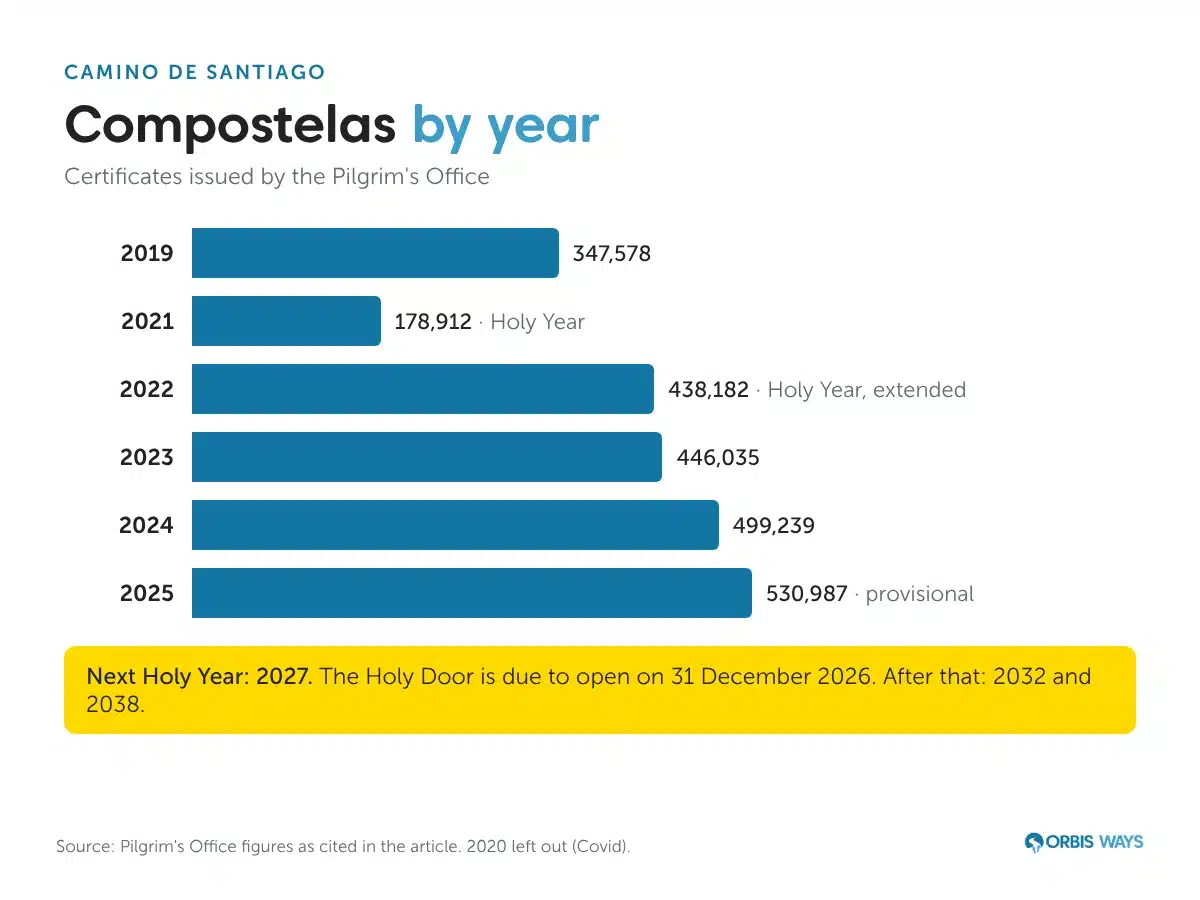
Source: Pilgrim’s Office (Oficina del Peregrino), Compostela register, as reported by secondary sites; accessed 2026-10-13. All figures on the official statistics page. Counts include only people who asked for a Compostela.
Every year since the last Holy Year has been busier than the Holy Year itself. In 2025, 530,987 people collected a Compostela, 21% more than in 2022. No official source has forecast 2027 numbers, and we won’t guess. What we do know is that the Camino is busy in a normal year now, so the tips below help whatever 2027 brings.
Arriving in Santiago during the Jacobean Holy Year
Most of what happens at the end of the walk is the same in any year. You collect your Compostela at the Pilgrim’s Office, and you can go to a Pilgrim’s Mass in the cathedral. Mass times change from time to time, so check the Cathedral’s own page close to your dates.
The Botafumeiro. This is the cathedral’s large incense burner, used on its main feast days. The Cathedral lists the days it’s used, among them 6 January, Easter Sunday, 25 July, 15 August, 1 November, 8 December, 25 December, and 30 December. The Botafumeiro may also be used during pilgrimages for which a request has been made to the Pilgrim Welcome Office. If seeing it matters to you, plan your arrival day around one of those dates.
Big events. Travel sites report a European Youth Pilgrimage (PEJ27) in Santiago from 15 to 18 July 2027. If you’d rather avoid big events, check dates like these when you choose yours.
How to plan a calmer Holy Year walk
Walk outside May to October
September is now the busiest month, ahead of August for the first time in 2025, and 83% of pilgrims arrive between May and October. So September isn’t the quiet option it used to be. April and October also grew sharply in 2025, so the shoulder months got busier too.
The other six months, November to April, saw 17% of arrivals between them. In winter the days are shorter, so the walking day has less room for long stops. Galicia is also a wet region in any season: Turismo de Galicia puts rain at about half the days of the year, varying by year and valley. A good rain layer earns its place in your day pack, whatever the month.
Not sure your dates will work? Ask us, and we’ll tell you honestly what to expect.
Start somewhere other than Sarria
Almost one in three pilgrims, 162,076 people (30.5%) in 2025, started the last 100 km in Sarria. It’s the classic one-week start, and our Camino Francés from Sarria in 7 days walks it.
If you’d like more room on the path, other trips also reach Santiago in a week: – the Portuguese Coastal Way from Vigo in 7 days; – the last week of the Camino Primitivo, from Lugo, in 7 days; – the Camino Portugués from Tui in 8 days.
Book early, then relax
Hotels fill earlier in busy years, so plan a few months ahead. Once your nights are booked, the rest looks after itself. Your luggage moves to the next hotel each morning, you walk with a day pack, and our 24/7 phone is there if anything comes up.
Is 2027 a good year to walk the Camino?
It depends on what you want from it. If walking through the Holy Door matters to you, 2027 is the year to go. The next chance is 2032.
If it doesn’t, walking in 2027 works the same as in any recent year: the same routes, the same rules, the same planning. Either way, the plan is the same. Choose your dates with care, think about where you start, and book your nights early.
A simple planning timeline for 2027
- Now: choose your route and how many days you have. Our Camino de Santiago routes page lays them out side by side.
- Next: pick your dates. If you can, look at the months outside May to October. If a feast day or the Botafumeiro matters to you, set your arrival day first and count back.
- A few months before: book your nights; we take care of your luggage transfers.
- Before you go: get your pilgrim credential; our first-timer’s guide explains where. Walk a few long days at home in the shoes you’ll take.
Your next step
Tell us when you’d like to go and how many days you have. We’ll send you a quote and honest advice on dates.



Request a quote
Tell us which trip and when, and we’ll send you a personalised quote.