
How to walk the Camino: a first-timer’s guide
Eight steps, from choosing where to start to collecting your Compostela in Santiago.
To walk the Camino for the first time, you need three things: a starting point at least 100 km from Santiago, a pilgrim credential to collect stamps in, and a plan for where you’ll sleep each night. The rest is walking, one stage a day, towards Santiago. This guide takes you through it in eight steps. If you haven’t picked a route yet, our Camino de Santiago routes page lays them all out.
Most first-timers walk the last 100 km, the minimum for the Compostela, in about a week. Get a pilgrim credential, collect at least two stamps a day on the last 100 km, walk one stage a day, and collect your Compostela at the Pilgrim’s Office in Santiago. On a self-guided trip your nights are booked and your bag moves ahead of you each morning.
1. Pick your starting point
Most people who walk the Camino for the first time walk its last 100 km or so, because that’s the minimum distance for the Compostela. The rule is about the end of the walk, not the start: those 100 km must lead into Santiago, with your last stage ending at the cathedral. If you cycle, the minimum is the last 200 km.
Almost one in three pilgrims, 30.5% in 2025, starts in Sarria, on the Camino Francés. Our Camino Francés from Sarria in 7 days is a week of walking to Santiago: 114 km over five walking days.
It’s not the only good start. Weighing up the Francés and the Portuguese Way? Our comparison helps you choose, and the Camino de Santiago routes page shows every route we run.
2. Choose your dates
The Camino is busiest between May and October: 83% of pilgrims arrive in those months. Here’s how the year looks for a walker:
- May to October: the main season. In 2025, September was the busiest month of all, ahead of August.
- April and October: the edges of the season. Both grew sharply in 2025.
- November to March: shorter days and fewer walkers. November to April together saw only 17% of arrivals. Galicia is wet in every season: Turismo de Galicia puts rain at about half the days of the year.
If you’d like a quieter path, look at the months either side of the peak. Our Sarria trip runs from February to November, and we recommend spring or autumn.
Walking in 2027? It’s a Holy Year, and our Holy Year guide explains what that changes.
3. Get your pilgrim credential
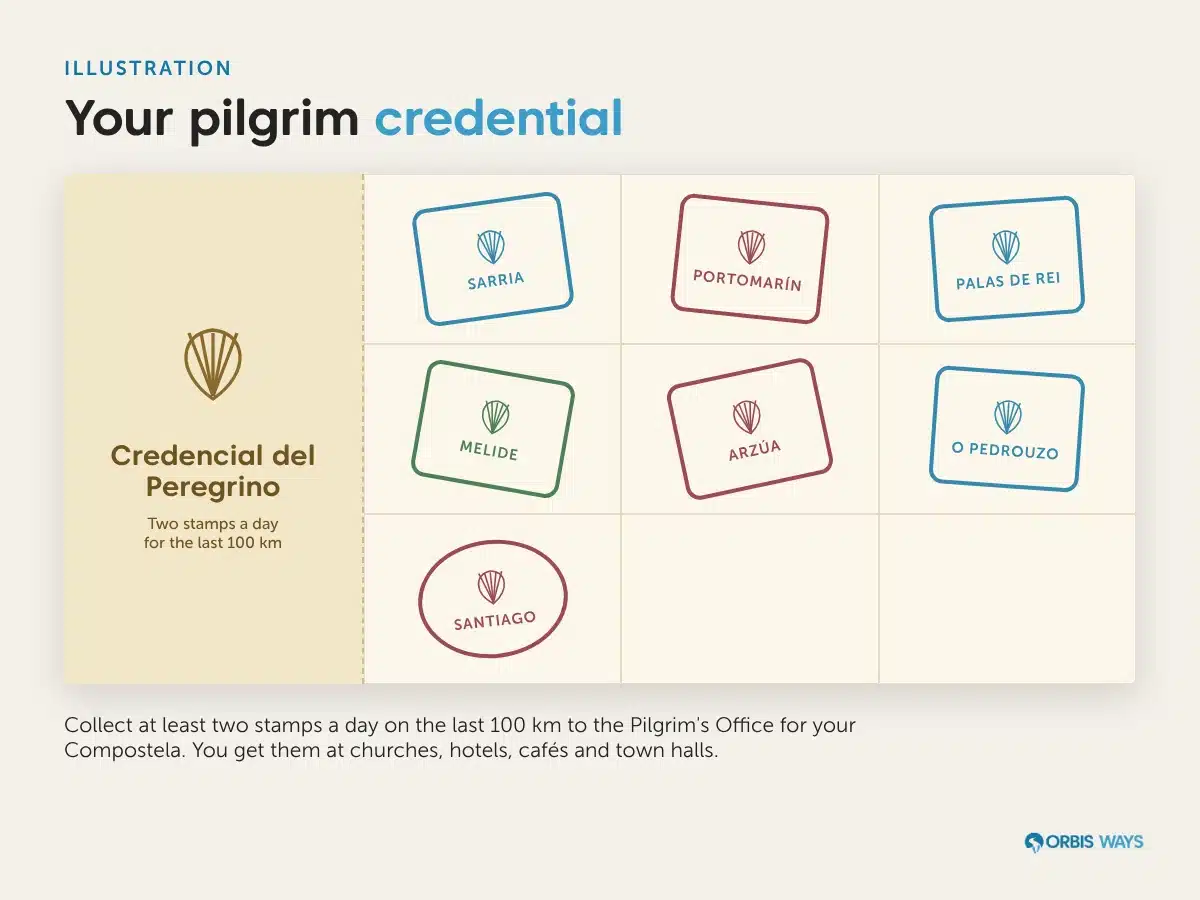
The credential, or pilgrim passport, is a folded card you carry and get stamped along the way. It’s your proof that you walked. You get it before you start. On our Camino trips, your credential is included.
Make sure it’s an official one. The Pilgrim’s Office accepts only the credential issued by the Cathedral of Santiago, or by an organisation the Cathedral authorises. You can pick one up in person at the Pilgrim’s Office in Santiago, or from authorised organisations such as parishes and pilgrim associations. In the UK and the US, you can also ask pilgrim associations such as the Confraternity of Saint James or American Pilgrims on the Camino.
There’s also an official digital credential: a Cathedral app that collects stamps by scanning a QR code, and works alongside the paper one. Only stamping points that have signed up have a QR code, so for a first Camino, paper is the simpler choice.
Keep it in a plastic sleeve, somewhere dry. You’ll show it at the Pilgrim’s Office at the end.
4. Collect stamps as you walk the Camino
Each stamp, or sello, shows where you were that day. Churches, hostels, hotels and town halls along the way have them, among many other places. On the last 100 km you need at least two stamps a day.
If you walk only the minimum distance, the Pilgrim’s Office asks for dated stamps at the start and end of each stage, so it’s clear you picked up where you stopped.
A simple habit: one stamp when you set off, one at lunch, one when you arrive. Your hotel’s reception may have one too.
5. Sort your nights and your luggage
You can do this two ways. Book every night yourself and carry your pack, or walk self-guided: your hotels are booked and your bag is moved for you. That’s how we do it.
On our Sarria trip, hotels and luggage transfers are included. Each morning you leave your bag at reception, walk with a day pack, and find it waiting at the next hotel. You get a technical dossier with every stage in it, and our 24/7 phone is staffed if anything comes up on the way. The transfer covers one bag per person, up to 20 kg.
6. Train and pack
You don’t need to be an athlete. You do need to be comfortable walking for several hours, several days in a row: on our Sarria trip, the walking days are 17.7 to 28.5 km.
Train by doing exactly that. Start a couple of months before you go. Begin with a few hours’ walking on the weekend, then add a second day, so you walk on back-to-back days. By the last few weeks, aim for two or three days in a row at about the length of your longest stage. If your route has climbs, find some hills.
Wear the shoes and socks you’ll take, and carry the day pack you’ll use. Break your shoes in at home; new shoes on a long walk are asking for blisters.
For your day pack: – water and a snack; – a light rain layer; – sun cream and a hat; – your credential and a pen; – a small first-aid kit with blister plasters; – your phone, with our 24/7 number saved.
For the bag that travels ahead of you: – layers you can add or take off, rather than one heavy coat; – a pair of socks for each walking day, or a few you can wash; – a second pair of comfortable shoes for the evenings; – something easy to wear at dinner.
7. What a day on the Camino looks like
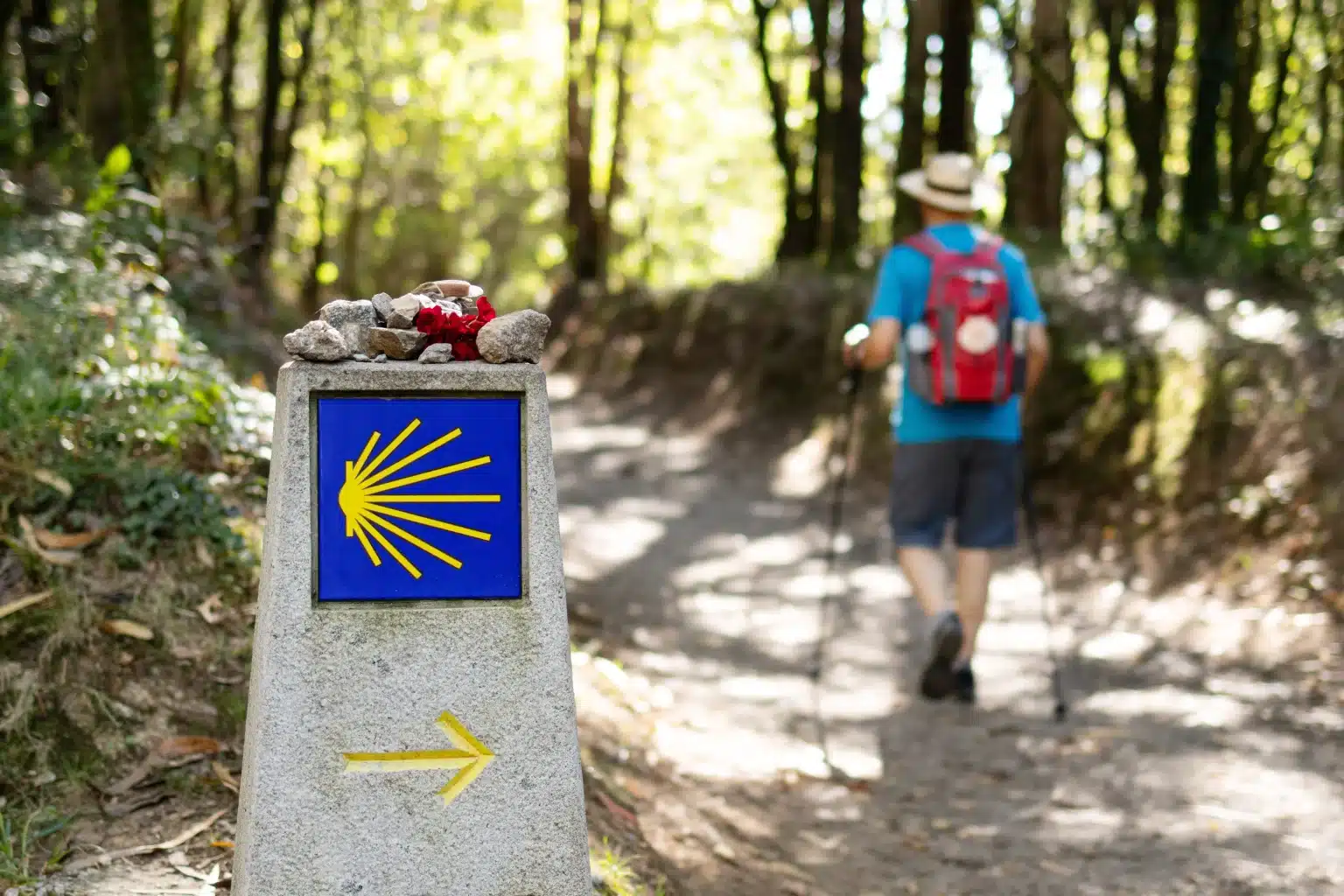
Breakfast at the hotel, bag at reception, and out of the door. You follow the yellow arrows towards Santiago, through the villages along the stage. Stop for a coffee when you feel like one, and pick up a stamp at a church or a town hall as you pass.
Walk at a pace where you can still chat. Take a short break every hour or two, and take your shoes off at lunch to let your feet breathe. If you feel a hot spot on your foot, stop and put a plaster on straight away, before it turns into a blister.
When you arrive at the next hotel, your bag is already there. Shower, a short wander, dinner. Read tomorrow’s stage in your dossier. Then you do it again.
8. Arrive in Santiago and collect your Compostela
When you reach Santiago, take your credential to the Pilgrim’s Office, at Rúa Carretas 33. It’s listed as open every day from 9:00 to 19:00, except 25 December and 1 January; older pages give different hours by season. You take a ticket with a QR code, which lets you follow the queue on your phone. Show your stamped credential, and they issue your Compostela.
You can also ask for a Certificate of Distance. It records where and when you started, how many kilometres you walked, your route and the day you arrived. It costs 3 €.
If you’d like to go to a Pilgrim’s Mass, the Cathedral lists Masses at the main altar at 7:30, 9:30, 12:00 and 19:30, and a Mass in English at 10:30 in the Pilgrim’s Office chapel, Monday to Saturday except Wednesday. Then sit in the square in front of the cathedral for a while. You’ve earned it.
Common first-timer mistakes
- New shoes on day one. Walk them in at home first.
- Forgetting the second stamp on the last 100 km.
- Thinking September is quiet. It was the busiest month in 2025.
- Carrying everything. On a self-guided trip your bag travels for you; walk with a day pack.
- Rushing. It isn’t a race. Leave time to stop.
FAQ
Can I walk the Camino alone?
Yes. A self-guided trip is made for it. Your nights are booked, your bag moves ahead of you each morning, and our 24/7 phone is staffed if you need help. You walk at your own pace, and you’ll share the path and the cafés with other walkers heading the same way.
Do I need to be religious to walk the Camino?
No. People walk the Camino for faith, for the walking, for time to think, or for all three. The routes, the waymarks and the hotels are the same for everyone. The Compostela itself is a religious certificate: the Pilgrim’s Office grants it to those who make the pilgrimage “with Christian sentiment”. At the end you can visit the cathedral if you’d like to, or simply sit in the square.
How is the Camino marked?
With yellow arrows and scallop shells. You’ll see them painted on walls, trees and posts, and set into stone markers. The arrows point towards Santiago, so when in doubt, look for the next yellow arrow. Keep the route notes from your dossier handy too, for any junction where you’re unsure.
How fit do I need to be to walk the Camino?
If you can walk for a few hours on several days in a row, you can walk the Camino. On our Sarria trip, the five walking days are 17.7 to 28.5 km. Train in the shoes you’ll wear, and if you’d like shorter days, ask about our Camino from Sarria in 11 days.
Do I need to speak Spanish?
No. A few words help, like hola (hello) and gracias (thank you). If you need help with a hotel, a pharmacy or a taxi, call our 24/7 phone. It’s staffed in English and Spanish, and we’ll help you sort it out.
What if I can’t walk one day?
Call us. If a stage turns out to be too much, or a blister makes tomorrow look long, we’ll look at the options with you. That’s what the 24/7 line is for. Before you go, take out travel insurance that covers several days of walking in a row.
Can I start my Camino on any day of the week?
The Camino is a public path, so you can start walking on any day. If you’re booking a trip with us, tell us the day you’d like to start, and we’ll confirm it in your quote.
Your next step
Tell us when you’d like to go and how many days you have, and we’ll send you a quote for your first Camino.


Request a quote
Tell us which trip and when, and we’ll send you a personalised quote.