
Tour du Mont Blanc itinerary: the classic circuit, stage by stage
Eleven stages, three countries and one big mountain in the middle. Here’s the classic Tour du Mont Blanc itinerary, day by day, and how to get to the start from Geneva.
The classic Tour du Mont Blanc itinerary is a loop of about 165–170 km around the Mont Blanc massif, through France, Italy and Switzerland. Most people walk it anticlockwise from Les Houches, near Chamonix, in 11 stages. It’s a high walk with a long climb to a pass on most days, so it suits fit walkers. Our Tour du Mont Blanc walking holidays cover it in shorter or longer trips.
Short answer The classic TMB runs anticlockwise from Les Houches in 11 stages: Les Contamines, Les Chapieux, Rifugio Elisabetta, Courmayeur, Rifugio Bonatti, La Fouly, Champex, Col de la Forclaz, Tré-le-Champ, La Flégère and back to Les Houches. Most walkers take 10 to 12 days, between mid-June and mid-September.
The Tour du Mont Blanc at a glance
| Distance | About 165–170 km, depending on variants |
| Climbing | Close to 9,000 m of ascent in total (one trail guide: 8,917 m) |
| Countries | France, Italy, Switzerland |
| Classic direction | Anticlockwise, from Les Houches |
| Stages | 11 in the classic plan; most walkers take 10 to 12 days |
| Season | Mid-June to mid-September |
| Where you sleep | Mountain refuges, village hotels, or a mix |
Sources: thegreatoutdoorsmag.com TMB trail guide; Cicerone guide listing (nhbs.com); montourdumontblanc.com. Read 14 Oct 2026.
Comparing it with other walks in the Alps? See all our walking holidays in France.
The classic Tour du Mont Blanc itinerary, stage by stage
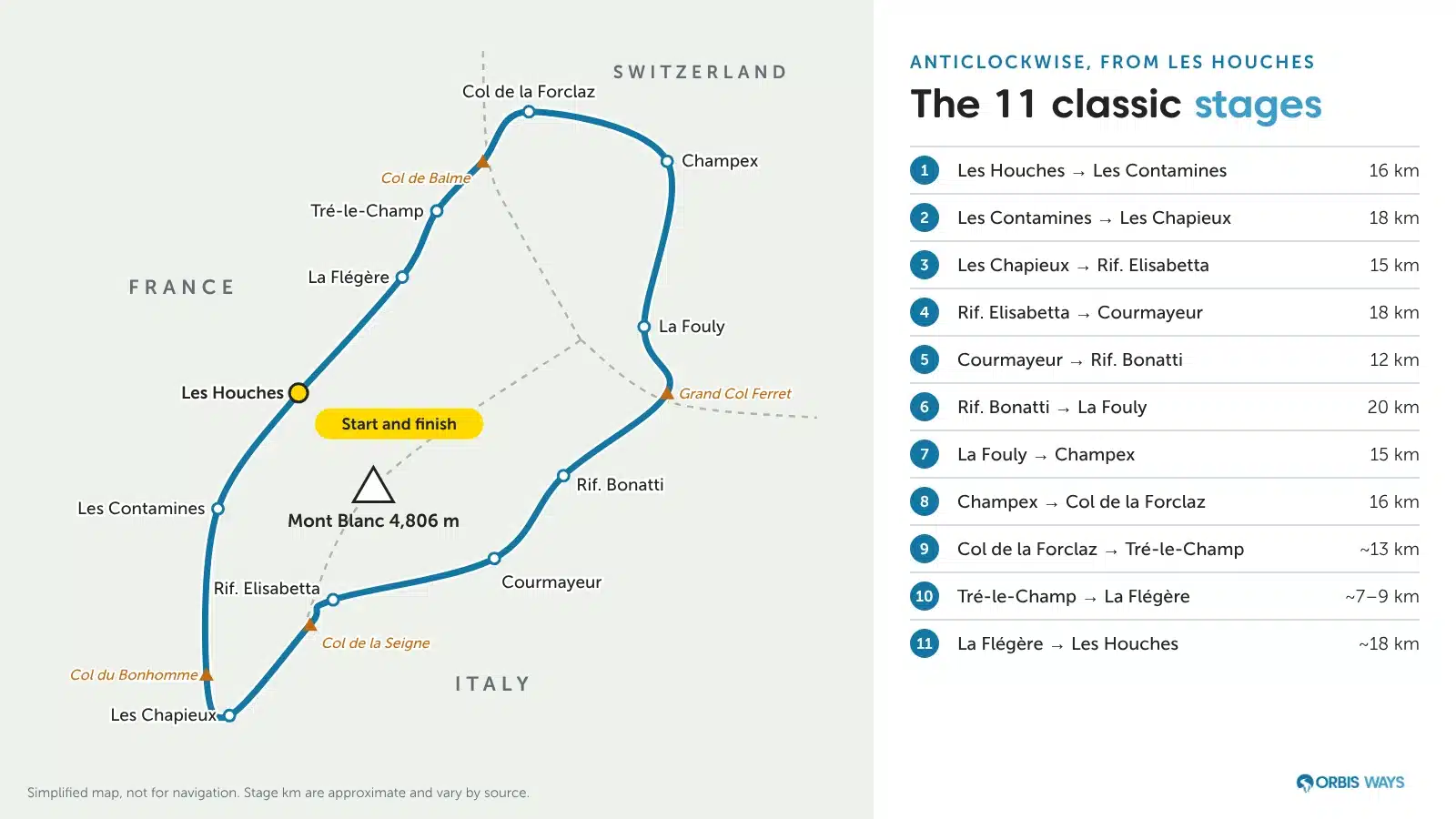
Here is the classic Tour du Mont Blanc itinerary, anticlockwise. Distances are approximate: guidebooks and GPS tracks differ by a kilometre or two. The Cicerone guide puts the daily distances between 7 and 21 km.
| Stage | From → to | Approx. km | Ascent (m) | Ends in | Pass or landmark |
|---|---|---|---|---|---|
| 1 | Les Houches → Les Contamines | 16 | 646 | France | Bionnassay |
| 2 | Les Contamines → Les Chapieux | 18 | 1,316 | France | Col du Bonhomme, Croix du Bonhomme |
| 3 | Les Chapieux → Rifugio Elisabetta | 15 | 1,004 | Italy | Col de la Seigne |
| 4 | Rifugio Elisabetta → Courmayeur | 18 | 460 | Italy | — |
| 5 | Courmayeur → Rifugio Bonatti | 12 | 860 | Italy | — |
| 6 | Rifugio Bonatti → La Fouly | 20 | 895 | Switzerland | Grand Col Ferret |
| 7 | La Fouly → Champex | 15 | 420 | Switzerland | Val Ferret |
| 8 | Champex → Col de la Forclaz | 16 | 742 | Switzerland | Alp Bovine |
| 9 | Col de la Forclaz → Tré-le-Champ | ~13 | varies by source | France | Col de Balme |
| 10 | Tré-le-Champ → La Flégère | ~7–9 | varies by source | France | — |
| 11 | La Flégère → Les Houches | ~18 | varies by source | France | Le Brévent |
Caption: Stages per the Cicerone TMB guide listing (nhbs.com/title/153689). Km and ascent for stages 1–8: Wikipedia, “Tour du Mont Blanc”. Stages 9–11: montblanctreks.com.au, moonhoneytravel.com, thedailypackers.com. Their climb figures differ, so we don’t give one. Read 14 Oct 2026.
Stages 1–3: France, then over into Italy
You start with the gentlest climb of the first three days, past Bionnassay to Les Contamines. Stage 2 is the first big day: 1,316 m up, over the Col du Bonhomme. Stage 3 crosses the Col de la Seigne into Italy.
Stages 4–6: Italy, then over into Switzerland
Stage 4 ends in Courmayeur, a common place for a rest day if you plan one. Stage 5 climbs to Rifugio Bonatti. Stage 6 is the longest day in the table, about 20 km, over the Grand Col Ferret into Switzerland.
Stages 7–8: Switzerland
Stage 7 has the least climbing of stages 1–8, just 420 m, down the Swiss Val Ferret to Champex. Stage 8 crosses by Alp Bovine to the Col de la Forclaz. There’s a higher variant here: the Fenêtre d’Arpette, at 2,665 m. It’s harder, with a long descent on rock, and one walker who has done it suggests keeping to Alp Bovine if the weather is unsettled.
Stages 9–11: back to France
The Col de Balme marks the border, and you cross it back into France on stage 9. Stage 10 is the shortest day, at about 7–9 km. On the last day you go over Le Brévent, then descend a long way, well over 1,500 m, back down to Les Houches.
How fit do you need to be for the Tour du Mont Blanc?
It’s an endurance walk, not a climb: no ropes or technical gear, but most stages have a long climb to a pass and a long descent, with close to 9,000 m of ascent over the whole loop.
The official TMB booking site gives a simple test: can you walk for six hours, with about 1,000 m of climbing and a pack on your back, then do it again the next day? On 10- to 12-day itineraries, the stages are shorter, at around four to six hours of walking.
Its suggested build-up takes about three months:
- First: two walks a week of 2 to 3 hours.
- Then: one long walk a week of 4 to 5 hours, with 800 to 1,000 m of climbing and a 6 kg pack.
Stage 2, at 1,316 m of climbing, is the first real test of your legs.
Source: montourdumontblanc.com, “Training for the TMB”. Read 15 Oct 2026.
What a day on the TMB looks like
- Start early. Summer storms mostly break between 2 pm and 5 pm, so the official TMB site advises an early start. Aim to finish by mid-afternoon.
- Follow the TMB signs. Signposts at junctions tell you where you are, where the path goes next and how long it takes. The shared marker is “TMB” with a black arrow in a green square, though other markings may vary from country to country.
- Carry layers. Alpine weather can change within hours, even in summer: sunshine can turn to fog, rain or a storm. Pack a waterproof, a warm layer, a hat and gloves.
Sources: montourdumontblanc.com; trekking-mont-blanc.com; macsadventure.com. Read 15 Oct 2026.
Hotels or huts?
The TMB passes both. Refuges sit on the high ground; hotels sit in the villages and valley towns along the way.
- Huts keep you high and on the trail. Many can only be reached on foot, so luggage transfer usually can’t reach them. The official booking site puts a dorm bed with half board at about €65–95 a night. Refuges supply blankets and pillows; you bring a sleeping bag liner.
- Hotels give you a private room in the villages along the route.
- Booking: the refuges in its association book through the official TMB site, and the popular ones are often full several months ahead. Others take bookings directly.
Our complete TMB, hotels and huts mixes both: you sleep in refuges at Les Mottets, Maison Vieille, Bonatti and La Boërne, and in hotels on the other nights. Your luggage moves between accommodations, except to Rifugio Bonatti, where you carry what you need for the night.
Which stages our trips cover
All our TMB trips are self-guided. They differ in how much of the loop you walk and how long you take over it. To compare them in full, see our Tour du Mont Blanc page.
| Trip | Days | Stages covered |
|---|---|---|
| The TMB short break | 5 | Stages 1 to 4, Les Houches to Courmayeur |
| The TMB in 8 days | 8 | Les Houches to Chamonix in six walking days, with a shorter day from Courmayeur to Champex |
| The complete TMB, hotels and huts | 12 | Full loop, in hotels and mountain huts |
| The complete TMB in comfort in 12 days | 12 | Full loop, mostly in hotels, with refuge nights at Les Mottets and Bonatti |
| The extended TMB in comfort | 14 | Full loop, with a rest day in Courmayeur |
Caption: Orbis Ways trip pages (EN sitemap, lastmod to 5 Oct 2026). Stages per trip from each trip page, 29 Oct 2026.
Getting from Geneva to the start
From Geneva Airport, Chamonix is about 87 km by road. You have three options:
- Bus: a direct bus runs from Geneva Airport to Chamonix several times a day. It takes about 1 hour 40 minutes.
- Shared shuttle or private transfer: about 1 hour 15 minutes to 1 hour 30 minutes, depending on traffic.
- Train: there’s no direct train. With changes, plan on three to four hours or more.
From Chamonix, Les Houches is about 7 km by road down the valley: around 17–18 minutes on the Mont Blanc Express train, or 13–20 minutes by bus. Check the current timetable before you travel. Our trips start in Les Houches, and you make your own way there from Geneva by bus or train; each trip page sets out the options. If you’d rather walk to Chamonix than ride, there’s also our walk from Geneva to Chamonix in 8 days.
Sources: rome2rio.com; mountaindropoffs.com; monkeysandmountains.com; thetrainline.com; omio.com. Read 14–15 Oct 2026.
When to walk the TMB
The season runs from mid-June to mid-September, when the passes are clear of snow and the refuges are open.
- Mid to late June: snow can still cover high sections, and some refuges aren’t open yet. Until mid-June, several passes keep snow patches on their north side, including the Bonhomme, the Col des Fours and the Fenêtre d’Arpette.
- Mid-July to mid-August: the busiest weeks, when refuges fill fast.
- September: quieter, but some refuges close for the season.
The official booking site opened refuge bookings for summer 2027 on 15 October 2026, so book your huts early. Our own TMB trips run from early July to mid-September. One note for stage 2: the Refuge de la Croix du Bonhomme is being renovated, with reopening planned for June 2029.
FAQ
Can you walk part of the Tour du Mont Blanc?
Yes. Several operators, us included, sell shorter sections of the loop as well as the full circuit. Our TMB trips run from 5 to 14 days, so you can match the walk to the time you have, and come back for the rest another summer.
Can you walk the TMB clockwise?
Yes. The classic direction is anticlockwise from Les Houches, but clockwise works too. Some of the climbs are steeper that way, so for a first TMB the classic direction is the gentler choice. The stages and huts are the same either way.
Do I need a guide for the TMB?
Not on our trips. They’re self-guided: you walk at your own pace, with a technical dossier that covers the route and a 24/7 emergency phone if anything goes wrong.
Do I need cash on the Tour du Mont Blanc?
Yes, carry some. Many refuges don’t take cards, and drinks aren’t included with dinner. You cross three countries: France and Italy use euros, Switzerland uses Swiss francs, though walkers report that euros were accepted on the Swiss stages. Cash machines are few on the trail; Chamonix, Courmayeur and Champex are the main places to top up.
Do I need a map if the TMB is signposted?
Carry one. Signposts mark the junctions, but in fog or on a variant you’ll want to check where you are. The Cicerone map booklet shows the whole route on 1:25,000 IGN maps and works in either direction.
Our verdict
The classic Tour du Mont Blanc itinerary is 11 stages of long climbs, high passes and three countries. If you have less than two weeks, walk part of it at a pace you enjoy. Our Tour du Mont Blanc walking holidays offer both the full loop and shorter options.
Your next step
Pick the version of the TMB that suits you, then request a quote with your dates.


Request a quote
Tell us which trip and when, and we’ll send you a personalised quote.