
Accommodation along the Camino de Santiago: where you’ll sleep
From pilgrim dorms to old manor houses, here’s what each kind of bed means for your day on the trail.
Accommodation along the Camino de Santiago comes in four kinds: pilgrim albergues, small pensiones, rural houses and hotels. Which one you choose shapes your whole day, from when you set off to how well you sleep. This guide is for walkers who’d like a private room at the end of each stage. We’ll be fair to albergues too, because plenty of pilgrims love them. Whichever of our Camino de Santiago routes you walk, the choices are much the same.
Albergues are pilgrim hostels with dorm beds: cheap and sociable, but you share the room. Pensiones and hostales are simple private rooms. Rural houses are country homes that take guests, some of them old manor houses. Hotels are graded from one to five stars. Our Camino trips are in hotels, with luggage transfers between stages.
1. The four kinds of accommodation along the Camino de Santiago
Every Camino ends in Galicia, and Galicia sorts its places to stay into official groups. Here’s what each one gives you.
| Type | Your room | Who it suits | Booking |
|---|---|---|---|
| Albergue (pilgrim hostel) | A bed in a shared dorm | Budget walkers who enjoy company | Public ones: limited booking; private ones vary |
| Pensión or hostal | A private room | Walkers who want privacy at a modest price | Usually bookable ahead |
| Rural house (casa de turismo rural) | A private room in a country house | Walkers who like quiet villages and old buildings | Usually bookable ahead |
| Hotel | A private room, one to five stars | Walkers who want comfort after a long day | Usually bookable ahead |
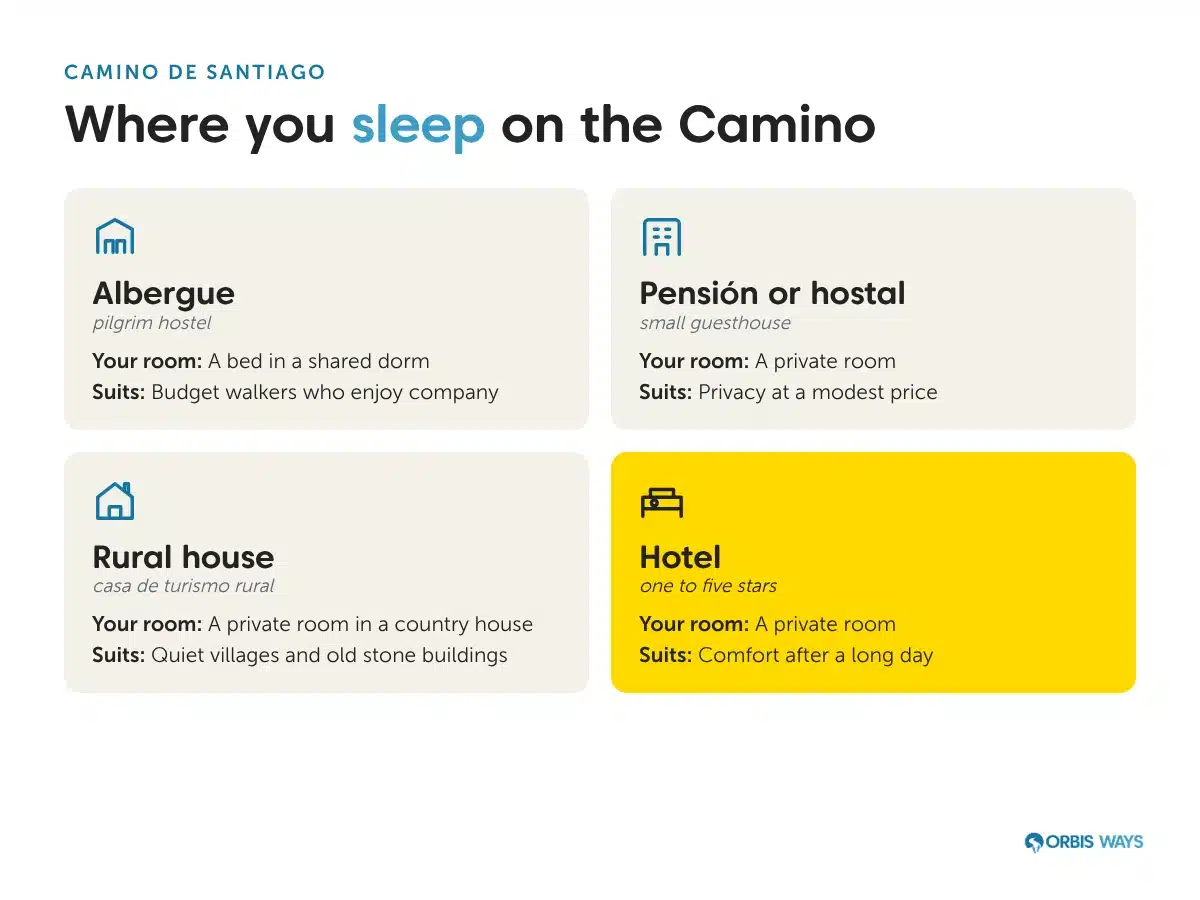
Table sources: Xunta de Galicia, Decreto 57/2016 (hotels and pensiones) and Decreto 191/2004 (rural tourism); Xunta albergue booking platform (2020). Checked 14 Oct 2026.
Albergues
Albergues are the classic pilgrim hostels. You sleep in a shared dorm and share the bathrooms. Galicia has a public network of albergues on the Camino, run by the regional government, and there are municipal and private ones too. Public albergues are meant for pilgrims and usually ask to see your credential. The Xunta’s booking platform lets you reserve a bed from 1 pm the day before.
They’re the cheapest beds on the Camino and the most sociable. The trade-off is simple: you share the room, so how you sleep depends on your neighbours.
Pensiones and hostales
A pensión is a small guesthouse with private rooms. In Galicia, pensiones are graded with one to three stars, and only two- and three-star pensiones may call themselves a hostal (Decreto 57/2016). It’s the simplest way to get a door you can close at the end of the day.
Rural houses
Rural houses, or casas de turismo rural, are country homes that take guests. Galicia groups them by the building itself: group A covers pazos (manor houses), castles, monasteries, large houses and old rectories; group B, village houses; group C, working farmhouses; and group D, whole rural villages (Decreto 191/2004; Turismo de Galicia). If you like old stone and quiet lanes, look for these.
Hotels
Hotels in Galicia are graded from one to five stars (Decreto 57/2016). Stars tell you about facilities, not about the welcome, so read what a hotel offers walkers: an early breakfast, a place to dry your boots, a quiet room at the back. That’s where a team that knows the route helps.
2. Albergue or hotel: what changes in your day
Where you sleep changes more than the bed.
- When you set off. Where beds go to whoever arrives first, some pilgrims leave very early to be sure of one. With a booked room, you leave when you’re ready.
- What you carry. Most albergue walkers carry everything on their back. With hotel stays, a luggage transfer can move your bag for you.
- How you sleep. A private room means your own space, your own pace in the morning and a proper rest before the next stage.
- Who you meet. Albergues are where many Camino friendships start. In a hotel you’ll still meet pilgrims every day on the path.
Neither is right or wrong. It depends on your budget, how you sleep and how much you’d like to plan each day.
3. How hotel stays and luggage transfers work together
This is where hotels make the biggest difference. Our Camino trips are in hotels along the route, with your nights booked before you set off. Luggage transfers between stages are included. You leave your bag at reception in the morning, walk with a day pack, and your bags will be waiting at the next hotel. The transfer covers one piece of luggage per person, up to 20 kg.
If something comes up on the way, our 24/7 emergency phone is staffed day and night, in English and Spanish. You also get a technical dossier with every detail of the route, so you always know where tonight’s hotel is.
You can see how this works on a real trip: walk from Sarria in 7 days, in hotels, with luggage transfers included.
4. Booking ahead in a busy year
The Camino keeps getting busier. In 2025, 530,987 pilgrims collected a Compostela, 21% more than in 2022, the last Holy Year. Almost one in three, 30.5%, started in Sarria, and September was the busiest month.
2027 is a Holy Year, because 25 July falls on a Sunday. Hotels fill earlier in busy years, so plan a few months ahead, especially if you’d like to start in Sarria or walk in September.
Two calm ways to find more choice:
- Walk outside May to October. 83% of pilgrims arrive in those months.
- Start somewhere other than Sarria. The Portuguese coast from Porto in 14 days is a whole Camino in two weeks, in hotels with luggage transfers.
Common mistakes
- Assuming every albergue takes bookings. Public ones have their own rules, and private ones vary. Ask before you count on a bed.
- Booking a bed far off the route. A room a few kilometres from the waymarks adds those kilometres twice: once in the evening, once the next morning.
- Leaving September late. It’s now the busiest month on the Camino, not a quiet one.
- Forgetting the stamps. If you’d like the Compostela, collect two stamps a day on the last 100 km. Hotels can stamp your credential too.
- Packing as if you’ll carry it all. With your bag moved between hotels, your day pack only needs what you’ll use on the walk.
FAQ
Can I stay in hotels and still get the Compostela?
Yes. The Compostela depends on how far you walk and on your stamps, not on where you sleep. The Pilgrim’s Office asks you to walk at least the last 100 km and collect two stamps a day. You can get stamps in hotels, churches, monasteries and town halls, as well as in albergues.
Is there anywhere special to stay in Santiago?
The Parador de Santiago, on the cathedral square, began life in 1499 as a royal hospital for pilgrims. According to Paradores, it still offers free meals each day to the first ten pilgrims who show their credential and their Compostela. Book early if you’d like to finish your Camino there.
Can I mix albergues and hotels?
Yes. If you walk on your own, you can stay in albergues on some nights and book a private room on others. Our trips are hotel-based, so you’ll have a private room at the end of every stage.
Can I stay an extra night somewhere?
In public albergues, the usual rule is one night only, unless you’re ill. Hotels don’t have that limit. On our trips, you can add extra nights: ask about a rest day when you request your quote.
Your next step
Tell us when you’d like to walk, and we’ll suggest a route and the hotels that fit.


Request a quote
Tell us which trip and when, and we’ll send you a personalised quote.